Evidence of progress
Green turtles: protecting today for recovery over decades
In 2025, IUCN improved the green turtle’s global category from Endangered to Least Concern. Decades of beach protection, reduced capture and cooperation lie behind this change. It is specific progress that must be read alongside the threats that remain.
Visual explainer · 5 min read
Recovery of a long-lived species needs protection at sea and on land, sustained over time.
How it works
Step 1 / 4
Protect nesting beaches
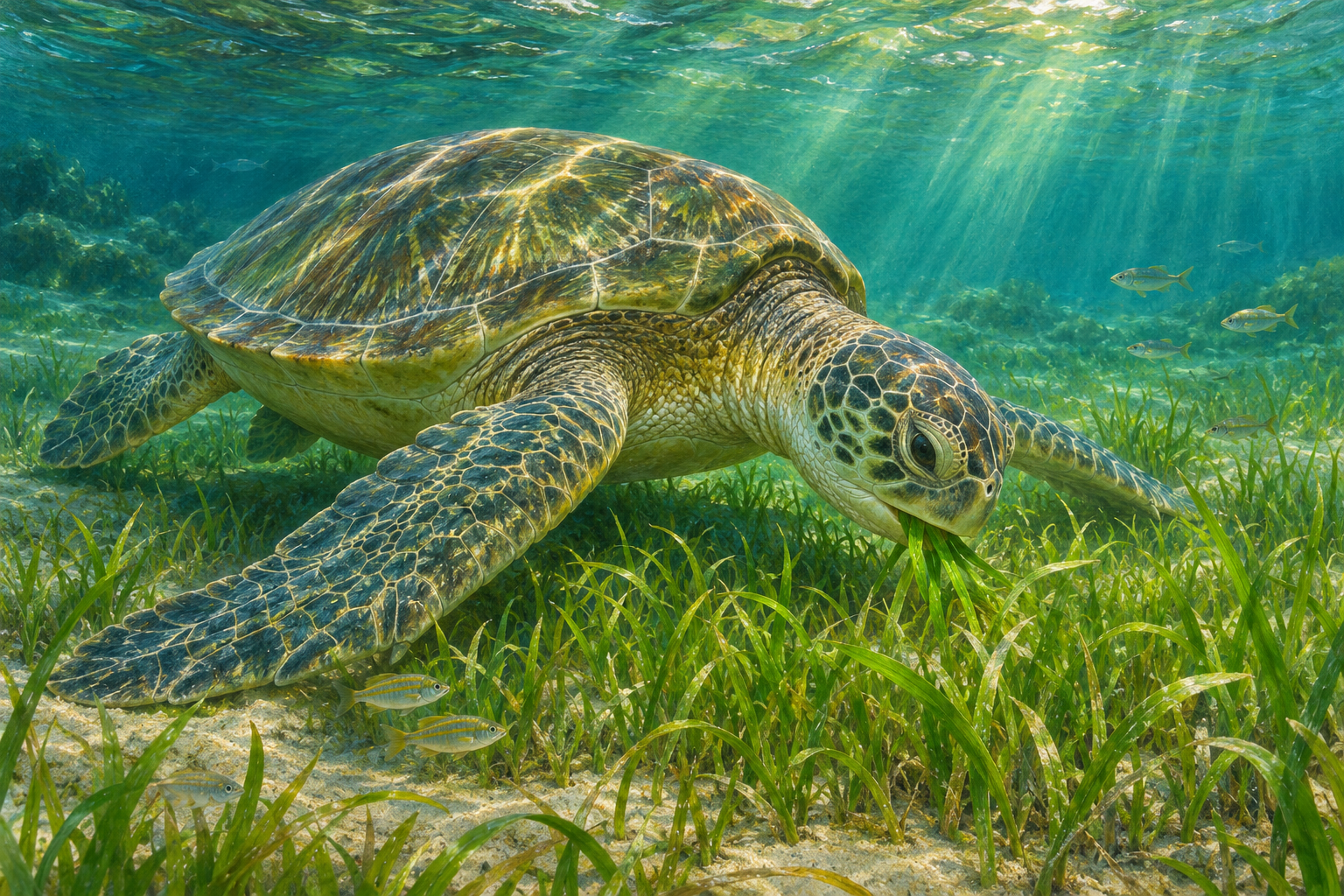
Females lay their eggs on beaches. Protecting nests and females, limiting capture, and avoiding obstacles or disruptive lighting can improve survival. Seeing many hatchlings reach the sea is not enough: many risks still lie ahead.
Context illustration, not to scale. Select a step to explore the process.
People are part of the story
Conservation depends on coastal communities, fishers, authorities and researchers. Measures need to consider livelihoods, local knowledge and how costs are shared. Respectful beach visits and support for monitored programs help more than handling animals for photographs.
What the evidence tells us
2025: documented global improvement
The global Red List assessment moved to Least Concern in 2025. IUCN links recovery to sustained protection of females and eggs, limits on exploitation and reduced accidental capture. The category describes global extinction risk, not an absence of threats.
IUCN · Red List update: green sea turtle recovery ↓IUCN SSC Marine Turtle Specialist Group · Red List assessments ↓Local scale still matters
IUCN notes that some subpopulations remain threatened and global abundance remains depleted relative to historical levels before commercial exploitation. A favourable global result can coexist with breeding difficulties at a particular colony. Local monitoring and protection remain necessary.
IUCN · Red List update: green sea turtle recovery ↓NOAA Fisheries · Green turtle biology, threats and conservation ↓What can help
Keep beaches functional
Following local rules, reducing disruptive lighting and leaving nesting space protects reproduction. Following trained staff guidance avoids harmful interventions.
Work with fisheries
Testing and maintaining bycatch-reduction measures with their users helps turn a technical solution into effective, verifiable protection.
Sustain monitoring
Funding long time series and cross-border cooperation helps detect new threats. Assessing survival and habitats complements nest counts.
What to keep in mind
Least Concern does not mean protections can be removed. Warming, sea-level rise, habitat loss and capture still matter. This recovery does not show that every sea turtle species is improving either: each needs its own assessment.
Sources and further reading
- IUCN · Red List update: green sea turtle recovery ↗2025-10-10
- IUCN SSC Marine Turtle Specialist Group · Red List assessments ↗
- NOAA Fisheries · Green turtle biology, threats and conservation ↗
- NOAA Fisheries · What Can You Do to Help Sea Turtles? ↗
- NOAA Fisheries · Fishing Gear: Turtle Excluder Devices ↗
- Florida FWC · Green Turtle Nesting in Florida ↗
EkoPulse explanation based on the cited sources. Original AI-generated illustrations for EkoPulse; they are not photographs or research figures, and do not imply endorsement by the cited institutions.
Editorial review: