Understand a challenge
Food waste: making use of what we already produce
A meal that ends in the bin carries some of the work, water, land and energy used to produce it. Food waste occurs in shops, restaurants and homes. Understanding where and why it happens helps prevent it, alongside improving the management of unavoidable scraps.
Visual explainer · 5 min read
The first aim is to prevent surpluses; then use safe food and manage remaining scraps well.
How it works
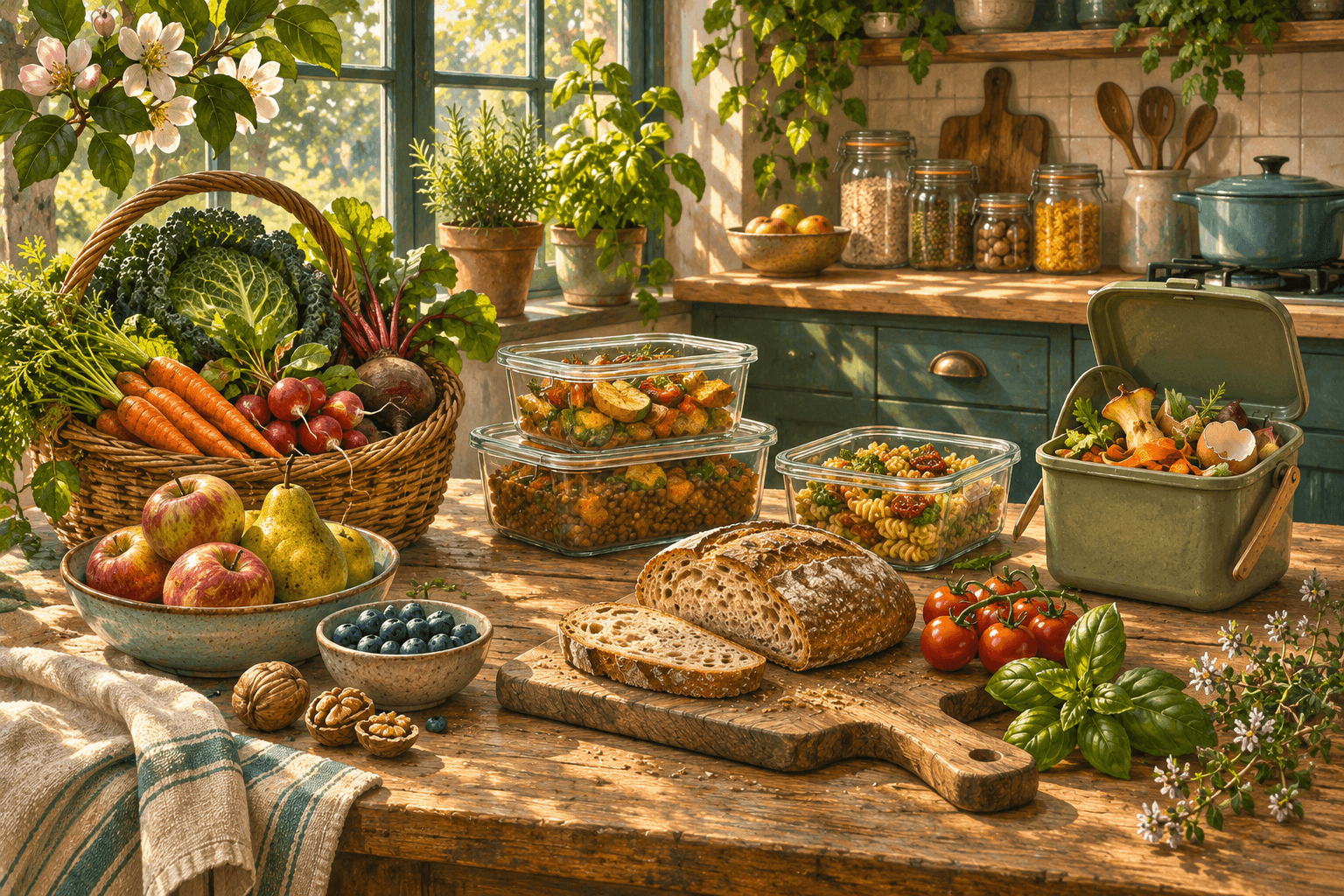
Step 1 / 4
Produce and distribute
Before reaching a kitchen, food involves growing or rearing, processing, storage and transport. Each product has a different history. Discarding it also wastes some of those resources, although different foods do not have identical environmental footprints.
Context illustration, not to scale. Select a step to explore the process.
People are part of the story
Caterers, shops and households face different barriers. A family may lack time, refrigeration or affordable pack sizes. Redistribution can help use safe surpluses, but dignified access to food also requires income, access and services; distributing leftovers alone does not resolve food insecurity.
What the evidence tells us
An estimate with a defined scope
UNEP’s 2024 report estimated that 19% of food available to consumers in retail, food service and households was wasted in 2022. It includes inedible parts: it is not 19% of all global production or a measure of hunger.
UNEP · Food Waste Index Report 2024: scope and 2022 estimates ↓Prevention differs from treatment
EPA’s environmental scale prioritises preventing waste and using food to nourish people over disposal. It compares management pathways, rather than providing a complete assessment of their social or economic costs.
US EPA · Wasted Food Scale ↓What can help
Measure before changing
Recording what is discarded and why helps adjust orders, portions and preparation. Measuring again tests whether the change works.
Use safe surpluses
Planning, suitable storage and organised redistribution can avoid discards. Food safety and recipients’ needs should guide decisions.
Manage unavoidable scraps
Separate collection and suitable composting can return organic matter to soil. They complement prevention, rather than justify generating more surplus.
What to keep in mind
Estimates change with coverage and methods; a difference between reports does not automatically indicate real improvement or deterioration. Upstream loss and downstream waste percentages cannot simply be added because their denominators differ.
Sources and further reading
- UNEP · Food Waste Index Report 2024: scope and 2022 estimates ↗2024-03-27
- UNEP · Food Waste Index Report 2024 ↗2024-03
- FAO · Food loss: definition and supply-chain stages ↗
- FAO · The State of Food and Agriculture 2019 ↗2019
- US EPA · Wasted Food Scale ↗
- US EPA · Prevent Wasted Food Through Source Reduction ↗
- US EPA · Composting and landfill impacts ↗
EkoPulse explanation based on the cited sources. Original AI-generated illustrations for EkoPulse; they are not photographs or research figures, and do not imply endorsement by the cited institutions.
Editorial review: