Evidence of progress
The ozone layer: recovery in progress
A global atmospheric problem prompted a shared response. Reducing ozone-destroying substances is allowing this natural protection to recover, although the process takes decades and continued monitoring.
Visual explainer · 5 min read
Cooperation can change an environmental trend; sustaining it matters as much as starting it.
How it works
Step 1 / 4
A natural shield
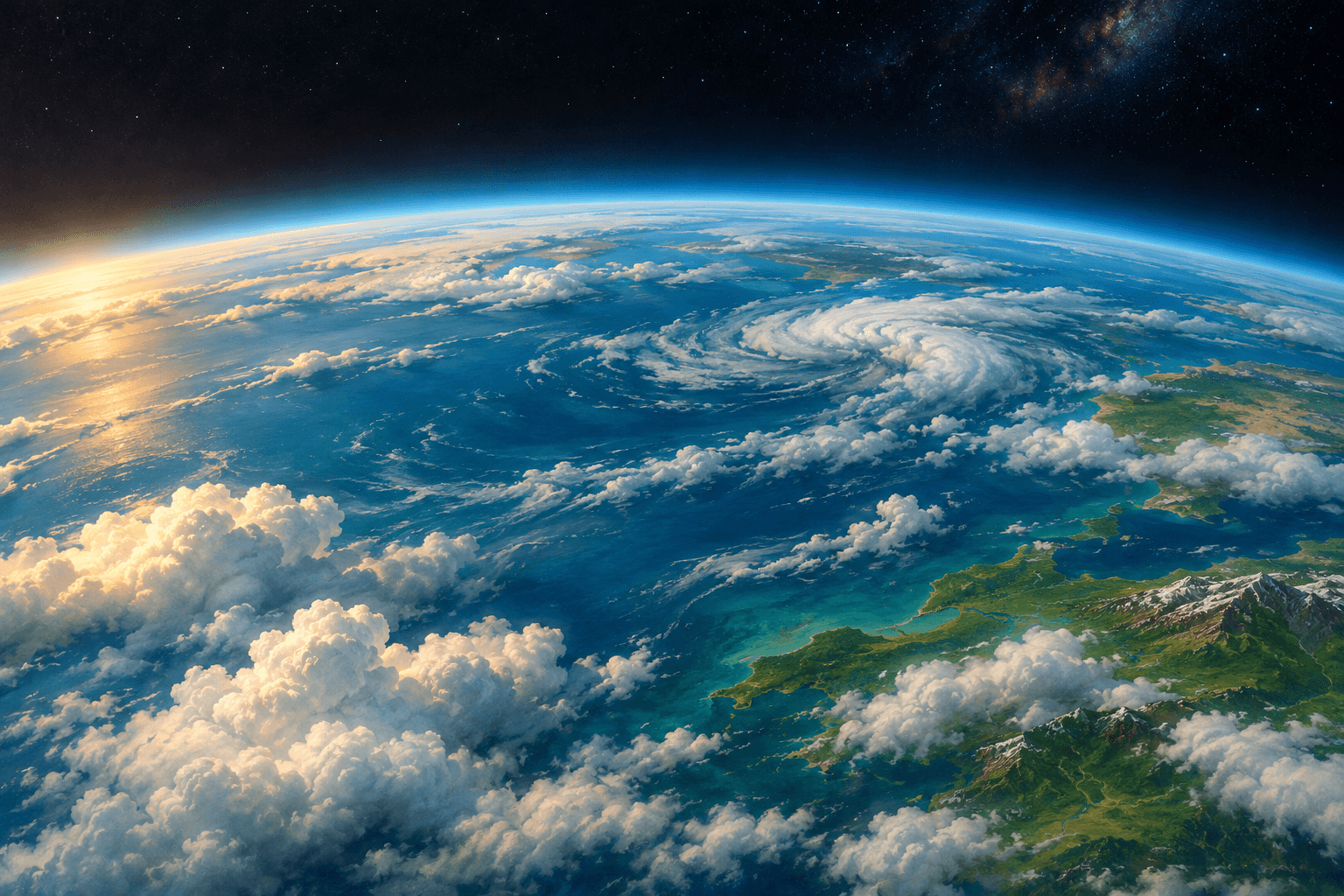
In the stratosphere, ozone absorbs much of the Sun’s ultraviolet B radiation. It is not a solid cover: it consists of molecules dispersed in air that continually form and break apart.
Context illustration, not to scale. Select a step to explore the process.
People are part of the story
This protection matters for health and ecosystems: greater UVB exposure increases skin cancer and cataract risks and can harm plants and aquatic organisms. Recovery does not remove the need for sun protection.
What the evidence tells us
Observed: improvement with variability
WMO’s September 2026 bulletin describes the 2025 Antarctic ozone hole as one of the smallest in recent decades. One favourable year alone does not demonstrate full recovery: weather also influences its size.
WMO · Ozone Bulletin: successes and challenges ↓Projected: dependent on compliance
The 2022 scientific assessment projects total ozone returning to 1980 levels around 2040 for the near-global average, 2045 in the Arctic and 2066 in Antarctica, assuming Protocol compliance. These are projections, not achieved results.
WMO / UNEP · Scientific Assessment of Ozone Depletion ↓What can help
Maintain rules and support
Cooperation needs finance, training and accessible alternatives to sustain technological change.
Manage existing equipment
Maintenance and professional refrigerant recovery when equipment is retired help prevent leaks of stored substances.
Measure to correct course
Satellites and ground stations track trends and reveal unexpected emissions. Agreements need this continuing verification.
What to keep in mind
Protective ozone aloft is different from the ozone pollution we breathe near the ground. The ozone hole is not the main cause of global warming either. This experience offers lessons in cooperation; it does not mean every problem has the same remedy.
Sources and further reading
- WMO · Ozone Bulletin: successes and challenges ↗2026-09-16
- WMO / UNEP · Scientific Assessment of Ozone Depletion ↗2022
- WMO / UNEP · Twenty Questions and Answers About the Ozone Layer ↗2022
- US EPA · Basic Ozone Layer Science ↗2026-03-04
- US EPA · Health and Environmental Effects of Ozone Layer Depletion ↗2026-04-09
- UNEP · About the Montreal Protocol ↗
- European Commission · Ozone layer overview ↗
- NASA / NOAA · 2025 ozone hole monitoring ↗2025
EkoPulse explanation based on the cited sources. Original AI-generated illustrations for EkoPulse; they are not photographs or research figures, and do not imply endorsement by the cited institutions.
Editorial review: