
Chemical weathering
What does it mean?
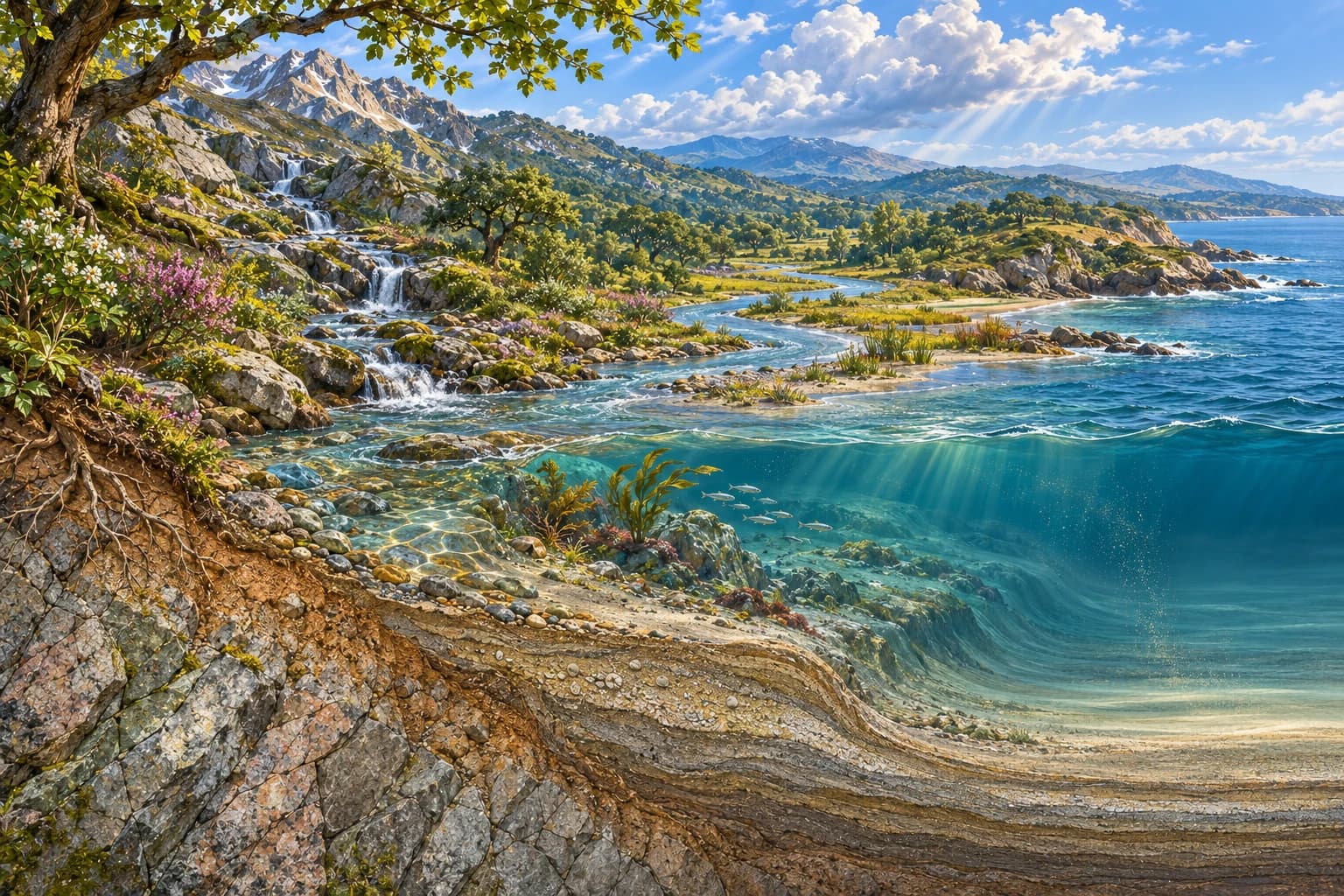
Reactions between water, CO₂ and minerals can remove atmospheric carbon over the long term.
Warmer, wetter conditions can accelerate silicate weathering. Together with subsequent carbon transport and burial, this helps regulate climate over geological time.
How the loop works
- 1
Earth warms

- 2
Water–rock reactions can speed up

- 3
Weathering and burial remove CO₂
- 4
Initial warming is dampened

↻ − The effect opposes the initial change; it does not guarantee a return to the previous temperature.
What we know
It is part of the geological carbon regulator; temperature and the water cycle affect the reactions.
What remains uncertain
It depends on minerals, erosion and water supply. It is too slow to rapidly offset current emissions; not all rock dissolution removes CO₂ durably.
Timescale
Global regulation over thousands to millions of years.
Sources and credits
Based on Ripple et al. (2023), One Earth. Study loop: 20.
- Kump, L.R., Brantley, S.L. and Arthur, M.A. (2000). Chemical weathering, atmospheric CO₂, and climate. Annual Review of Earth and Planetary Sciences 28, 611–667.
Educational adaptation and AI-assisted illustrations: EkoPulse.